Normally at this time of the year I would be busily occupied with preparing my garden for its winter siesta. This would include my usual season angst of having to cut back all the remaining blooms, even though they still provide a splash of color to the otherwise brown and shrivelled up annuals that gave up the fight. Planting fall bulbs...applying fall fertilizer... The usual.
Since one year ago, the fall to-do list is no longer applicable since we are now enjoying the benefits of condo living. No longer is the responsibility of ensuring the perennials survival over the winter is in my hands. The new owner can now deal with the guilt that arrives in Spring when the thaw reveals those that didn't make it through the winter. It's somebody else's responsbility now.
As an avid but frustrated gardener, my efforts now focus on patio gardening...or patio planting. In the Spring I joined the masses hitting the gardening centres to purchase flowers and plants but my focus was on which species would survive living in urns. We bought four hanging planters containing flowering plants that were already in the midst of a blooming boom. Three survived but there was one failure, which was due to the placement of the plant directly above the barbeque. Surprisingly, the plant didn't die, which would have been easier to accept along with the accompanying guilt, but instead kept growing leaves and leaves and... It's as if it was saying: 'please don't take me down! See? I can still give you pretty leaves!' The guilt just never ends!
The best results came from our urns that absolutely thrived due to a perfect balance of light and sunlight thanks to the overhang from the balcony above. Their success is due to the purchase of the special mix of earth created specifically for urns and boxes. Never realized how important a role that earth can make in flower beds and if only I had paid more attention to this aspect in my garden... However, life is full of could-have's, would have's and should-have's for gardeners. Right?
We also brought along our wood flower boxes that played host to a cornucopia of lush blooms, which over-flowed the sides and stuck out of the balcony rails. Anybody walking by and looking up at them would have gasped... Okay maybe not gasped but would have been very impressed with the display.
Unfortunately, it's that time to say goodbye since the stalks are now thin and "leggy" and suffering from a seasonal fungus that can only be cured by a return to the earth from which they came. There is no guilt since I know everything was done to ensure their longevity for the summer. Kind of a reciprocal relationship. I'm already planning for next year. Maybe some tomatoes might be a challenge... Radishes...and herbs. Condo gardening is flower raising without the guilt. At least so far but then we're still in the early stages. There's always next year.
Friday, September 26, 2008


Thursday, November 08, 2007
THE PLANT DOCTOR IS OUT!
by Eleanor Tylbor
Today I'm feeling guilty even though there's no real reason for it. As a plant raiser it's common to assume the blame for the demise of a favoured specie and there's always the usual post-mortem 'should-have-would-have-could-have' that follows. It's bad enough having to deal with the death of one's own plants but when they belong to 'others' the guilt is disconcerting to say the least. What type of an explanation can be offered in the way of an excuse? It was an accident? A good news/bad news account i.e. your plant enjoyed living in the flower box and provided a flourish of color. Bad news: it croaked?
Am I anguished? Consumed with guilt? You bet!
A couple of weeks ago I was asked to intervene in some problematic tropical plants living in an indoor flower box that were slowly dying.
"You know all about house plants," were the exact words uttered by the owner who handed me the box in the hope of a miracle resurrection.
Do I know about plants! Moi! The person who once had a gardening show on public access television, focusing on how to get the best out of an almost-dead garden.
KNOW: (vb) knew/knowing; to perceive directly; have understanding or direct cognition of; also to recognize the nature of: to be acquainted or familiar with
Many green species from many sources have graced the corners and windows of our home ranging from your store-bought tropical and floral types to more earthly beginnings as fruit seeds. However death has stalked many - more than many - following my interventions. This isn't the type of information one divulges when asked to administer first aid of the chlorophyll-type.
Anyway, the ailing box of plants, a gift from a valued business acquaintance, held the primo position in the reception area where it could be admired by everyone entering the office. Once the deterioration process set in and the inevitable slip into the hanging on for dear life but not quite dead state, the plant was wisely removed from public view. It was for this reason it ended up on my doorstep, literally and figuratively.
Asking a self-professed "green-thumber" the seemingly innocent question as to whether a plant can be saved is akin to issuing a personal challenge, and intimating that there is doubt it can be achieved by mere human intercession. Many plant people consider themselves divinely blessed with special healing abilities.
A cursory examination revealed mini spider webs indicating flying visitors in a feasting mode. Let it be stated for the record that enlightening neophyte owners to the presence of spider mites is not a wise move, since it inevitably triggers a fit of scalp scratching followed by a quick departure. There wasn't even enough time to explain that spider mites are vegetarians.
Amateurs!
While towering over the plants to assess the extent of the problem there was this brief sensation of being omnipotent with the power of life and death in my hands. Following a brief pep talk that included a flourish of compliments regarding their leaves and species, they were given a natural pick-me-up tonic frequently administered to my own houseplants, consisting of dissolved gelatine powder in water. Most of my plants - those that remain - have always responded favourably by producing a flourish of new leaves. To maximize growth potential the box of plants was placed in an area that received diffused light but not direct sun light, which could burn their leaves. In retrospect those plants received better care than members of my family.
Eleanor's Plant Growing Diary
Day 1. Assessment of problem: black tips on leaves indicating something is wrong. Solution: give plants a healthy dose of dissolved gelatine in water
Day 2. One of the plants keeled over and died last night. Solution: remove evidencedead plant
Day 3. Black tips have extended down to cover half the leaves on some of the plants. Checked houseplant book for possible cause. None available although there was mention of an incurable virus. Solution: isolate plant to another area of the room that doesn't receive much light. A bad move on my part.
Day 4. Woke up to yet another dead plant. The box is beginning to look sparse. Solution: spread out leaves of remaining plants to make it appear more full than it is. Gave the plants another pep talk i.e. "please-oh-please no more death!"
Day 5. Completely and utterly demoralized. Out of the original six plants, only three live and two are ivy. I mean, who can kill ivy? Perhaps not a good question in light of current events. According to another plant book they probably acquired an incurable virus at point of origin, which cannot be cured, even with divine intervention or my help. Go explain that to the owner!
Day 6. Turned over soil with plastic spoon. Figured if it works in the garden, it couldn't do any harm in the box. Accidentally dug up an unseen plant originally thought to be dead
Day 7: Seriously considering replacing the "dearly departed" with some new plants. Problem exists in that I can't remember the types of plant and which went where
Day 8. Received a phone call from the owner as to an update and was advised that the box is being picked up. Panic!
Day 9. Owner will be here in an hour. Panic!
Day 10. Plant box has gone along with my credibility. I mean, it was only plants, after all! There was no reason for the name-calling! Gave owner one of my avocado plants in the way of an apology along with the assurance of free avocados within three months
In case anybody wants to know, the doctor is out. Got that?
Monday, August 27, 2007
FITTONIA LIVES...FOR NOW
My fittonia is still in the land of the living but no thanks to Walmart. If there's an underlying (or underlaying...whatever) message to this whole experience is don't trust Walmart's plastic information sticks because they lie. Perhaps 'lie' would be a little too strong. Let's say the sticks don't know anything about the plants in which they are inserted.
My stick as did all the other information sticks so that should say something in itself, instructed the care giver to "little light. Very little water." My interpretation of these words was to place it away from direct light and in a shady place and to water it only when the soil was dry. By now I should have developed a sense of humor when it comes to houseplant raising but the truth is - I haven't. Their eventual demise always gets to me.
It began with the shrivelling of the leaves and then their eventual fall followed by the stalks losing color. Before moving we had an intimate chat as to our relationship in that it would have a place in the new apartment as long as it showed signs that it wanted to live. Things didn't look promising for a while, however, desperation and a strong desire to assume the role of giver and extender of life, I gave it a healthy dose of water and placed it in front of a window that received diffused light. Behold and verily, verily - a miracle happened! Over the the next few days the plant's white veined leaves returned to their former healthy state and tiny buds appeared at the leaf junctions. To say I was jubilant - and shocked - but obviously pleased with this miracle (at least I like to think it was and is a miracle) would be an understatement.
So now fittonia receives the conventional houseplant care and appears to be loving it. Keep my experience in mind when Walmart has a sale on houseplants: information sticks are liars.
Wednesday, May 02, 2007
Day 2: fittonia update: the news is not so good
So as instructed on the plastic information stick(?) I've been keeping my fittonia away from direct light...whatever that means. Presumably, it's telling me to keep it away from the sun.
Check.
The stick instructions also maintain that it doesn't like too much water.
Check.
However, barely 24 hours in my care and home, the tips of the leaves don't look so well. They are sort-of shrivelling and turning the dreaded brownish-blackish.
A consult was in order so I thumbed through the pages of my "Directory of House Plants" for some help or direction to take. According to the book Fitty needs high humidity and my house is drrrry. This does not bode well. The proverbial icing on the cake is the sentence: "Difficult to keep unless the humidity is high, but plants do well in a bottle garden."
Bottle garden?
This got me thinking. Perhaps - just perhaps - I could slice the top off a 2 litre soft drink bottle and Fitty could move in. Kind of a "bubble plant" type of existence. The attention value would be great especially when friends visit.
"Um...I don't want to seem instrusive," one of my nosy friends would most likely comment, "but is there any reason why your plant is in a Coke bottle?"
Going into lengthy explanations as to the rationale behind my move i.e. bottle+humidity=life for Fitty, would just make me appear even more weird than they already believe I am. Or I could place Fitty in a plastic zip-lock bag sprayed with water and see what happens.
So today Fitty is moving in to a zip lock bag. Maybe it'll work...or maybe it won't. More reports forthcoming.
Check.
The stick instructions also maintain that it doesn't like too much water.
Check.
However, barely 24 hours in my care and home, the tips of the leaves don't look so well. They are sort-of shrivelling and turning the dreaded brownish-blackish.
A consult was in order so I thumbed through the pages of my "Directory of House Plants" for some help or direction to take. According to the book Fitty needs high humidity and my house is drrrry. This does not bode well. The proverbial icing on the cake is the sentence: "Difficult to keep unless the humidity is high, but plants do well in a bottle garden."
Bottle garden?
This got me thinking. Perhaps - just perhaps - I could slice the top off a 2 litre soft drink bottle and Fitty could move in. Kind of a "bubble plant" type of existence. The attention value would be great especially when friends visit.
"Um...I don't want to seem instrusive," one of my nosy friends would most likely comment, "but is there any reason why your plant is in a Coke bottle?"
Going into lengthy explanations as to the rationale behind my move i.e. bottle+humidity=life for Fitty, would just make me appear even more weird than they already believe I am. Or I could place Fitty in a plastic zip-lock bag sprayed with water and see what happens.
So today Fitty is moving in to a zip lock bag. Maybe it'll work...or maybe it won't. More reports forthcoming.
Tuesday, May 01, 2007
Plastic plant information sticks are liars!
A new "baby"of the chlorophyll-kind has joined the "family" known as a "Fittonia" and although its a real cutie, I see heartbreak ahead. Bought at Walmart for $1.69 the plastic information stick advises that this specie likes "a little light and very little water." Problem is how valid are the instructions especially when it's applicable to 200 other plants types?
The way that I see it and read things, all tropical plants fall into one of two categories:
a) "Little light. Very little water."
or...
b) "Lots of light. Water generously"
That's it folks!
According to information obtained on the Web, this specie requires extra-special care. Here's a photo of the newcomer on the Wiki site and some information:
http://en.wikipedia.org/wiki/Fittonia
Can't help but note the somewhat disturbing blurb, "without water for a few days, this plant is known to "faint" but is easily revived with a quick watering and resumes its healthiness."
Oh gawd! Just what I need! A flower that faints at the slightest provocation! More guilt! If I go away for a short or longer vacation, my son who believes that all plants are created equally could either over-water or under-water her/him/it!
Furthermore, "the Fittonia is known to be difficult to grow so it is best bought at a nursery then cared for."
This just might be a really short relationship.
Anyway, according to the instructions and advice on the plastic stick, Fittonia likes "little light - Very little water." Maybe yes and maybe no.
What I want to know is who writes these information blurbs, anyway? Is it somebody who actually knows about plant raising or someone in public relations who also writes blurbs for fortune cookies? Perhaps on occasion she/he gets them mixed up and we houseplant raisers get the wrong information. Someone might crack open a fortune cookie and hoping to get some advice on their love life, might instead read: "lots of light. Water generously." At least that would explain all the deaths in the "family."
So Fittonia - I'll call her Fitty for short - is bathing in sunlight. Why I don't know because maybe she would prefer shade. I think she would prefer shade but go know! In the end a guess is as good as a plastic stick.
Writers & Friends
www.jrslater.com/forum
Saturday, April 28, 2007
SPRING HAS SPRUNG...tra-la tra-la
"Oh, give us pleasure in the flowers today; And give us not to think so far away As the uncertain harvest; keep us here All simply in the springing of the year."
(Robert Frost)
FIRST SPRING LOOK INTO THE GARDEN
My rock garden has what started out to be multi-colored achillea millifolium a.k.a. yarrow, but for some unknown reason changed to plain, old pink flowers, in addition to achillea filipendulina a.k.a. fern leaf yarrow (yellow), bergenia cordifolia a.k.a. pig squeak, which really doesn't belong in a rock garden but I like it there because of its early-blooming pink flowers and the leaves that start out green and slowly turn pink-ish as the summer wanes, I think - not sure yet - I lost the campanula lactiflora, which had such pretty lavender-colored flowers. On the side of the rock garden that is in the shade there is hosta rectifolia that I'm using as an anchor between the rocks.
"The Amen of nature is always a flower."
(Oliver Wendell Holmes)
There is a lot of sedum planted in various areas of the rock garden when we first bought the house that I have divided over the years. One thing about this species is that it never lets you down and returns year after year. There are also (very) mature evergreen miniatures that really should be removed and replaced since they're in that not-alive-but-not-dead-either netherland state of being. I'm a very sentimental gardener.In the back flower bed against a fence I'm growing beds of rudbeckia that have taken over a large area but their pretty yellow heads with brown centres blowing in the breeze are just so...happy-looking.
"In the spring, at the end of the day, you should smell like dirt."
(Margaret Atwood)
Way in the back hidden under the bough of a fir tree that my next door neighbor agrees not to trim, a white and pink gypsophila plant is growing relatively well, with some years better than others. The anemone are also flourishing and although this is a strong flower that has a tendency to take over the garden, it doesn't transplant well. On the shady side of my house I had a beautiful bed of pink dianthus flourishing there for years but for some bizarre reason, which I can't fathom for the life of me (I'm so dramatic!), they up and died, each and every one. The blue-colored Forget-me-nots will bloom in the middle of May and there is something so lovable - at least for me, anyway - about these blooms. Guess it has to do with their name.
In addition to my Iris bed on the sunny side of the house, I also have a scattering of purple coneflowers sort of hiding between the iris leaves. The effect is nice, though. Then of course we have the hollyhocks, that are supposed to be a biennial but return every year since they self-seed.
There are more but I can't remember their names right now but I'll check later on the garden sites. I mainly use two gardening books that I bought on sale at a local book outlet: "An Illustrated Guide to Garden Flowers" and "Popular Flowering Plants." Thing is that while I love the beautiful photographs, many of the species would croak in my growing zone so I really should be buying books that are specifically geared towards Canadian growing zones. One of my best gardening books...actually a soft-covered book was picked up for $1.50 at a second-hand store. Very, very basic but all-inclusive so gardeners don't have to pay a lot of money to get good advice.
Sunday, April 08, 2007
A GARDENING STATE OF MIND: FAVORITE GARDENING SITES
Glancing out of my window at light snow falling, it certainly doesn't resemble anything Spring like and definitely doesn't send one into a gardening state of mind. Be that as it may it won't be long before gardeners will be tilling the earth, seeding and all the other steps that they hope will result in a successful growing season.
When it comes to gardening everyone - at least most gardeners - have a favorite site to which they return for information. These are the sites that offer the basic "how-to's" or ABC's of getting things to grow and more importantly, to live and hopefully, thrive.
Achieving a successful garden depends on the garden's geographical location and using species that are natural to that particular area. Other factors involved are the length of the growing season, the amount of sun, rain fall, etc. Here are some of my favorites:
Icangarden
http://www.icangarden.com/- a Canadian site, it contains a wealth of information about all aspects of gardening with information suited for all areas of the U.S. and Canada. Helpful articles, live chat with experts, Kidz Korner, Gardening Communities...more
GardenWeb http://www.gardenweb.com/ - "The Internet's Garden and Home Community". Resources including a botany base, forums, photo galleries
National Gardening Association
http://www.garden.org/home - "The National Gardening Association (NGA), founded in 1973, is a nonprofit leader in plant-based education."
Site contains plant finder, weed library, pest control, etc. Over-all excellent resource
Cornell University Gardening Resources
http://www.gardening.cornell.edu/
Anything and everything(!) related to gardening and growing
If you're reading this then chances are you're a gardener. Share your (non-commercial) favorite sites with others so we all can become better growers!
Wednesday, April 04, 2007
SCHEFFLERA UPDATE - IT'S ALIVE
Well...the news is good - so far. My schefflera is still alive.
It's been approximately two weeks since it joined a couple of other plant oldies and its i.e. the plant, is holding its own. On one occasion there appeared to be small white-ish webs on the underside of the leaves so rather than use the "bad" spritz-spritz-kill-those-bugs stuff, I washed the entire plant with tap water. Of course it could have been just plain dust bunnies and not spider mite webs, but we plant owners can't and shouldn't take chances.
I'm still lonely for the dearly departed fern and am contemplating buying another fern-type. Fern's premature death could have been as a result of plant/owner anxiety separation and now that I'm home, at least this reason/cause can be eliminated.
As for the schefflera while it's still alive, its just...there. No new leaves and no signs of anything, actually. I've moved it around the room in the hope of seeing some new sprouting but that hasn't worked.
Maybe it requires vitamins. I shall now focus upon getting the plant to bud.
To be continued...
Sunday, March 25, 2007
IT'S GREEN...IT HAS LEAVES...IT'S A SCHEFFLERA
Following the death of...the passing...croaking of the fern, I am somewhat pleased to announce the arrival of a new plant. I use the term "somewhat" since nothing can immediately replace that cute, little sassy fern, which stole my heart! There was something about the way she/he grew in that special fern-ish medium a.k.a. dirt with those unique-ish delicate fronds extending from the earth....
Enough mourning.
As I wrote a new plant, a schefflera, has joined the household. I've always admired this specie when passing through the garden centres with its umbrella-like leaves plus it was on sale at Walmart for $2.29. One i.e. me, wonders how 'they' arrive at these weird prices for items. Like $9.97 or $3.39... Be that as it may it was too good a bargain and opportunity to pass up.
One doesn't just pick up the first plant that one lays eyes on because in my humble opinion, the weak species are always placed in the front by store personnel who receive their orders from plant growers.
"Dear Store Clerk or whoever is reading this," they most probably write. "Please note that in spite of our efforts to produce flaw-less species, some of our plants are rejects. To maximize their chances of being sold to suckers...plant lovers, please place this houseplant and others similar in appearance in front of your display."
We're talking here about feeble plants or those with spider mites that will live on average a couple of months (most times less), after which they croak and then you feel guilty and assume the blame when in effect, it's all a big plot to unload those that don't make the grade. Believe me - I know!
After ten to fifteen minutes of looking over, picking-up-and-replacing many plants, finally the decision was made and the dye cast...whatever. The law of gravity even came into play. Pots/containers turned upside down to examine the underside of leaves will result in the falling of earth everywhere. Do scientists know about this?
According to various houseplant sites, raising schefflera is simplicity personified. There is one little downside to this plant, however (isn't there always?): spider mites! Seems that these absolutely ghastly insect interlopera love scheffies (I've already personalized our relationship)! Yesterday as a preventative measure I washed each and every leaf on scheffy, however, if there are any of the usual tell-tale signs of infestation i.e. weeny spider webs, I'll have to switch to insecticide soap. Of course I always use the environmentally-friendly stuff but as someone once mentioned: how friendly could it be given the end result. Always with the guilt.
Here's some garden-friendly sites worth visiting:
http://www.icangarden.com/document.cfm?task=viewcategory&categoryid=266
http://www.perennials.com/
http://gardeninglaunchpad.com/
Suggestions of your favorite gardening sites welcome!!!
www.jrslater.com/forum
Friday, March 09, 2007
The Suicidal Fern
Upon reading about the death of my fern whom I named Fern, it was suggested to me that perhaps - just perhaps - my fern committed suicide of the chlorophyll type. At first I scoffed and laughed at such a suggestion. I mean - c'mon - plant suicide? Then I thought further about this possibility. Is there no end to the guilt I must bear?
See...I left Fern, the fern, in the care of my son and daughter-in-law during a five week holiday, assuming they would at least be able to keep it alive until I returned. Although I'm sure they meant well, they're mere common houseplant caregivers with no experience in this type of species. So in conducting their weekly watering, they probably gave Fern an ample dose of tap water (not bought bottled water as Fern prefers and is accustomed to) to sustain her. Ferns are known to be emotional (somebody told me that) finicky and spiteful. Upon realizing that it was getting water straight from the tap, it probably/could have/might have turned on them (and me) and closed down. Given the temporary caregivers experience dealing with finicky species, they probably figured that the dark green shade it turned was normal, when in effect it was committing suicide.
Actually, I had thought about bringing along Fern on holiday with me but was worried we'd be stopped at the border since the transportation of plants out of the country is a no-no.
"What's that?" a customs officer might have asked, retrieving Fern and holding it up.
"Oh that? Well...it's a plant, kind customs person," I would have told the officer.
"Hmmmm...what type of plant? The kind that you roll the leaves and smoke? Huh?" he must have continued, examining Fern's leaves and sniffing the air.
"It's a fern, officer," I would have answered.
"Oh yeah? How do I know that?" he would have peppered me with questions.
"Trust me. Here - look at the plastic information stick they supply. See? F-E-R-N," I would have told the customs person."
"Perhaps...but you can't transport living things accross the border, y'know!" the customs person would have informed us, matter of factly.
"Why not? I bring him along!" I would have commented, pointing to my husband and laughing.
At that point my husband would, knowing him, chirp in and tell the customs person to confiscate the plant since he's a law-abiding citizen. He's also not a fern lover. Not a fern hater you understand but definitely not a lover or even liker, either.
As for the blooming Christmas Cactus that is covered in red blossoms - it probably flowered in my absence to punish me. Absence does not make the heart grow fonder. Trust me on that.
Wednesday, March 07, 2007
When is a Christmas Cactus not a cactus?
My Christmas Cactus is blooming and it's March. Just so bloody typical. In December it looked semi-dead and now it's producing flowers like its attempting to make up for lost time.
When all the other cactus (or cacti?) in the world give their all in December, my plant decides to belatedly welcome the holidays three months later.
Actually and according to plant experts, they're (Christmas Cactus) not really members of the cactus family that live in arid conditions but are raised in a tropical environment.
Go know! I've been treating them like prickly one's watering them perhaps every three weeks or once a month. Sometimes less.
I could be a plant torturer!
According to a plant site that focuses on the care of this plant, "...the key to getting Christmas cactus to flower during the holiday season, is the proper light exposure, correct temperatures and limited watering. So during the fall months, the Christmas cactus should be placed in a spot where it receives indoor indirect bright light during the daylight hours but total darkness at night."
I'm okay in as far as the watering part is concerned and CC is sitting on a bookcase in front of the window where it receives ample and direct sunlight.
So far, so good. One point for me.
At night time I make a point of closing the blinds for privacy but the plant benefits too and that's alright. Two more points in my favor.
The site also advises Christmas Cactus owners that the plant should not be placed near a door that opens and closes at night and to keep it away from drafts and heating ducts. Gimme a break! I will not live my live based on the whims of a plant that doesn't act normally! Then again neither does its caregiver but that as they say, is another whole story. This darn plant receives better care than many members of the family and chooses to defy logic by blooming on St. Paddy's Day.
I'm toying with the idea of repotting the plant. A little plant shake up now and then might bring it to its senses. Or not.
http://www.humeseeds.com/xmasccts.htm for some help dealing with errant Christmas Cactus.
Tuesday, March 06, 2007
RIP...fern plant!
My fern died.
I wasn't around to do anything about it and that makes it even worse. Ask me if I feel guilty. I do.
I entrusted Fern (my name for her) with a relative who wasn't familiar with ferns while I took a short vacation with instructions to follow the plastic information stick provided by the supplier. Perhaps she received too much water. Perhaps she didn't receive enough. Maybe it had too much light...or not enough light. Go know. When I returned, Fern was a shrivelled up mass of brown.
I feel like I let her down.
Sorry Fern. I tried.
Oh the angst and guilt of plant death!
Sunday, December 31, 2006
HAPPY HOUSEPLANT DAY!
At the beginning of a new year, it's a good idea to scan over the list of major holidays and circle the important days requiring special attention. For example the most obvious celebrations are Christmas, New Year, Easter, Thanksgiving Day, not to mention holidays marking special achievements in the vein of Johnny Appleseed or Saint Valentine for example.
While these holidays should and do get the recognition that they deserve, gardening and houseplant aficionados merit a special day put aside to honor "our kind." It is with this in mind that I propose the establishment of a new celebratory event called, "Houseplant Day."
The impetus for the creation of this holiday is to set aside a specific day once per year in which to acknowledge the contribution of houseplants to our lives. What would our lives be like without these living organisms that give us so much pleasure and ask nothing in return but habitual doses of water, fertilizer, leaf cleaning, re-potting, insect control from their caregivers?
As the caregiver to a droopy leaved Christmas Cactus, which is the grand-old-dame of the collection, a beloved prayer plant that folds its leaves together in prayer-like stance at the end of the day and a new and sassy addition in the presence of a selaginella kraussiana, keeping these three remaining friends of the chlorophyll-kind alive is a challenge. Over the past three years a finicky ficus bid me a fair adieu as did a sassy schefflera, thanks to of a horde of bugs that decided to call their soil home. Let's just say that the plants and their tormenters have returned to the earth.
Meanwhile, downstairs in the rec. room some senior plants are living out the remainder of their lives stationed in front of a small window, their only source of light. Admittedly, it's not a gracious end for these now tall and gangly plants, which really deserve the prime spots upstairs. The reality is that I've run out of windows and although any respectable houseplant lover would always find space, he-who-is-not-a-plant-lover has issued an ultimatum: it's an either “me or…” situation, the answer to which I'm still pondering.
The actual celebration of Houseplant Day would include an extra dose of food although upon reflection that may not be such a good idea, given their delicate constitution. Perhaps promote the idea of putting a day aside where sports enthusiasts would bring houseplants to a major sports event culminating in a giant fertilization ceremony at half time. Through marketing and publicity politicians could be convinced to promote an “adopt-a-houseplant” scheme since they are known never to pass up an opportunity to be seen by the public in a positive light. With enough publicity we might even convince political leaders to adopt a houseplant. They could hold up a houseplant in the air and address the public while sprinkling manure, which many voters would say is quite appropriate…
So, d'ya think it'll fly? Kind of a love it or leaf it situation.
(Whad'ya think? Should there be a Houseplant Day? Comments welcome!)
Sunday, October 08, 2006
IT'S CLOSING TIME: THE UN-COMPLETE GARDENERS DIARY
You know the summer is really over when you hear the squawks of flying Canada geese making their annual trek south (smart geese!). There is something majestic about the way they fly en masse in "V" formation, changing positions to conserve their strength. Sad and yet comforting at the same time. (http://www.hww.ca/hww2.asp?id=35&cid=7)
Even though the temperature will reach the mid '50's today, the time has come as it always does, to pull the annuals and shut down the garden for the season. How I dread this every year but particularly this season since the annuals are still quite perky and colorful. The perennials in the back garden including the Brown-eyed Susans are somewhat dull and moving into that shrivelled-up phase and the gigantic hosta leaves have turned soggy and yellow-ish in color as a result of evening frost, so it's time. Although the rock garden perennials have long since lost their flowers, the leaves are still fresh and crisp. I always wait until the last moment to cut these back and cover them with earth. Makes me feel like an undertaker! A few hollyhock plants (http://www.silkartist.co.uk/hollyhocks.jpg) on the sunny side of the house are still growing and producing flowers. This year I swear, some of the plants reached the 7 foot level. The problem with hollyhocks is that it is impossible to stake them especially since they're growing up against the wall of the house. I found some old hockey sticks under the sun deck and used them for support. They also made some visual statement for onlookers and locals walking by.
"Oh look! Hockey sticks growing in the earth! How original! Real Canadian spirit those Tylbor's have!"
I mean, I just can't...lop off their heads if they're making an effort to produce more flowers! Be that as it may - a gardener has'ta do what a gardener has'ta do... To quote the Queen in Alice in Wonderland: "off with their heads!"
Even though the temperature will reach the mid '50's today, the time has come as it always does, to pull the annuals and shut down the garden for the season. How I dread this every year but particularly this season since the annuals are still quite perky and colorful. The perennials in the back garden including the Brown-eyed Susans are somewhat dull and moving into that shrivelled-up phase and the gigantic hosta leaves have turned soggy and yellow-ish in color as a result of evening frost, so it's time. Although the rock garden perennials have long since lost their flowers, the leaves are still fresh and crisp. I always wait until the last moment to cut these back and cover them with earth. Makes me feel like an undertaker! A few hollyhock plants (http://www.silkartist.co.uk/hollyhocks.jpg) on the sunny side of the house are still growing and producing flowers. This year I swear, some of the plants reached the 7 foot level. The problem with hollyhocks is that it is impossible to stake them especially since they're growing up against the wall of the house. I found some old hockey sticks under the sun deck and used them for support. They also made some visual statement for onlookers and locals walking by.
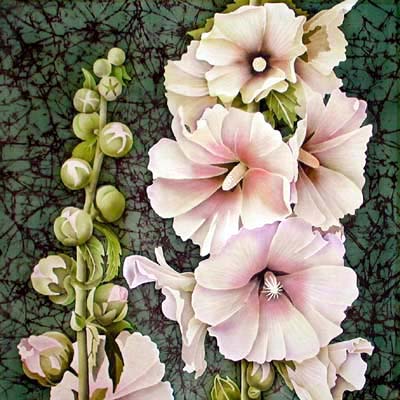
"Oh look! Hockey sticks growing in the earth! How original! Real Canadian spirit those Tylbor's have!"
I mean, I just can't...lop off their heads if they're making an effort to produce more flowers! Be that as it may - a gardener has'ta do what a gardener has'ta do... To quote the Queen in Alice in Wonderland: "off with their heads!"
"Those who contemplate the beauty of the earth find reserves of strength that will endure as long as life lasts. There is something infinitely healing in the repeated refrains of nature— the assurancethat dawn comes after night, and spring after winter."
- Rachel Carson
Thursday, July 06, 2006
GARDENER'S LAMENT - I'M FEELING NEGLECTED!
Given the copious amount of rain we've had, add to that the hot summer temperatures and my garden is doing splendidly. Now I'm feeling neglected.
Every year at this time there are the usual gardening touch-ups to be made like removing the weeds, dead-heading the flowers, lots of watering...the usual stuff. However, I've barely touched the garden because - well - the garden is thriving on my neglect! All that thinning out done last fall has paid off and the perennials are growing exactly where they are supposed to grow.
Darn!
The rock garden has never looked so good and all the perennials planted over the years is paying off. In fact there is hardly any more room for new additions. Maybe one or two. Three at the most.
Meanwhile, in the flower bed the older perennials are a blooming success and then some, with the newer additions kicking in as soon as the older blooms die. The rose bush that was about to be dug up has obviously received my mental image of the composter loud and clear and this season produced five fist-sized blooms. There aren't even any signs of fungus or black spot on the leaves, which eliminates the necessity to spray.
How demoralizing.
Even the 7 foot-plus hollyhocks whose stems usually bend in half being top-heavy, are remaining upright. This means I don't even have to support them as in past years.
The best I can hope for, generally, is that the annuals in the flower boxes will soon become leggy and require some extensive cutting and trimming. So now it's just a question of time. They'll all need me, eventually. They always do.
Monday, May 22, 2006
DEAR MOTHER NATURE...I'M REALLY UPSET WITH YOU!
Dear Mother Nature,
I'm writing to you today in near desperation. I know that this may seem like an unorthodox method in which to communicate with such an omnificent power, but desperate times calls for desperate measures.
Y'see Mom...Mother N - Mother Nature (don't wanna be disrespectful at this point since I'm asking for a favor) it has been raining daily here in Montreal for almost two weeks now. The fact that it's morally depressing is a given but it's about the tomato plant I bought two weeks ago. It's only one small plant growing in a large patio pot on the back sun deck (I use that term loosely given the amount of sun that we've received of late) but to me it represents the hope and dream of sinking my teeth into a blemishless, pink beefsteak tomato. Add a sprinkle of salt and it's heaven here on earth.
Okay. Forget the blemishless and I'll settle for a fully-ripe tomato. Okay. A tomato, period.
Thing is 'MN' - the blurb on the plastic information blurb supplied with the plant indicates that it takes 78 days from the day of planting for the tomatoes to be ripe and ready for eating. Given the fact that there has been a 2-week delay already due to the lack of sun - I'm in biggg trouble. If I had read the small print accompanying that beautiful colored photo of huge pink tomatoes on the vine, I would have realized that given our "normal" growing period of 3-4 months in a good year, this was not a wisest choice of species. Factor in the variety of insects that enjoy eating tomatoes 'al fresco' and it's an unachievable dream at best.
So now you understand the rationale behind my communicating with you: desperation. Whad'ya think, Mom? Can you help? It won't be a big effort on your part. I'll even settle for three days of pure, unadulturated sunshine. I mean - I don't wanna be greedy or anything.
With visions of tomatoes dancing in my head,
Eleanor
Thursday, May 04, 2006
SO HOW DOES YOUR GARDEN GROW? NOW THAT YOU ASK...
Every Spring as has been my habit since moving in our house, I conduct what I call "the walk-a-bout" to see if there have been any deaths of the chlorophyll kind. It's not a job that I relish since a death in the garden is like a personal loss having planted, coddled and fed the various species in the hope that they will flourish.
The bed of iris's, a specie that is almost impossible to kill and the main reason for its inclusion among my floral choices, haven't let me down. I anticipate yet another stunning bouquet of wine-colored blossoms, which I will share with my neighbors. The only draw-back if one can call it that is the ants who hide deep in the flower's interior and suddenly scatter like...ants when the stalks are placed in a vase of water. Nothing quite as attractive as ants crawling accross a beautifully set table when guests sit down to eat. On one occasion a few were spotted doing the dead man's float on a glass of white wine. Not a nice scene.
The honeysuckle shrubs cut down to 12" last month are at last growing some leaves and there are some pink flowers on a few. The neighbor who we call Mrs. Poopsy, owner of Poopsy the dog, continues to praise our decision for a radical cut in the hope that we'll keep them short. As she tells us at every opportunity, Poopsy has problems smelling (and presumably pooping) on rambling 6 feet high shrubs with long branches that can scratch Poopsy's bum.
This year there are signs that the one remaining rose bush is on its way to nature's equalizer known as the composter. The reality is that it should have been removed years ago but remains since there is always one stalk that is green at the base, although this year there is more brown than green. Green is the symbol of hope for we gardeners.
There was particular bad and sad loss in the rock garden. Our pride and joy, the yew shrubs are half dead. Of course a more positive way to look at it would be that they are half alive but I digress. The entire lower part of the shrubs is ghastly shade of grey and something will have to be done. More than likely the dead parts will be cut away with the end result looking like small trees growing in a rock garden. Let it not be said (or written) that we're not different.
On the shady side of the house Argy our gardener, over-raked again. This is an on-going spat with Argy assuming that dormant perennials are weeds or dead plants. This year's victim is the dianthus that have thrived in the bed for ten years. In spite of his denials of "You tell me don't rake - I no rake!" - he's a known plant murderer and in denial.
Today since the rain finally stopped and the sun is out, I'm going to finish the walk-a-bout. We'll see how the back garden bed made out. It's better I get there before Argy spots bare stems.
www.icangarden.com
Saturday, April 29, 2006
ZONING IN FOR GARDENING SUCCESS
After years of speculating as to the reasons why my garden doesn't thrive in the same way as do, it’s possible that the answer may lie under my feet, so to speak. Note the usage of the word "may", which is frequently followed by the words could have, should have, would have and that old favorite, might have been, since gardening is frequently a speculative undertaking at best. In fact the explanation is so obvious that it’s surprising it’s taken so long to arrive at this simple conclusion: I’m in the wrong zone!
Go know!
As a seasoned gardener I've rarely felt the need or desire to consult with the plant hardiness zone guide. That’s not exactly the truth. Thing is - and let’s keeps this from one gardener to another - I’m directionally-challenged! For me “south” conjures up visions of mint juleps and plantations, “north” is snow and mukluks, “out west” is tumbleweed and oil wells and “back east” is home base.
At this point you’re probably shaking your head in disbelief and astonishment, wondering how I can call myself a gardener and not know in which area my plant zone is located. Simple: I just never bothered to check for one reason or another. My philosophy is and has always been a plant is a plant to be popped into dirt along with a sprinkling of fertilizer and a dose of water. Leave it alone and chances are it'll grow or produce something interesting and green-colored. It now appears that I've been living under a misconception.
This fact was brought to my attention recently during a discussion with a successful plant person, about a new plant specie entering the market place, this summer. Concerned as to whether it would "take" or survive in my garden soil, the question arose as to the hardiness zone in which our house is located. No one had ever asked this question before and my credibility faded as fast as a hosta growing in sunny location.
Attempting to pass myself off as a credible source and being somewhat knowledgeable when it came to growing things, I spun a zoning tale.
"Perhaps zone five…” I lied, “but they’re in the process of making our area zone four or stretching it to zone six.”
The wonderful thing about the Internet is that it supplies information on just about everything a person needs to know about gardening at one's fingertips. Finding the plant hardiness zone map was simple enough but deciphering it was a whole other issue. What struck me was that visually, the map has a lot of eye appeal with pretty colors ranging from your earth tones of browns, beige and yellows, purple and soft lavender, lime to leaf green and for one reason or the other, an unimaginative dull black. There was also a zoom-in and zoom-out device presumably for verifying the exact location of the area in which a garden is located. According to the map we're situated in a light-ish green to mint-green area known as 5b…or maybe it could be 5a…it's a close call… At least we're in a region that's located in a decent color shade and one that's fashionably acceptable. Things like that are important to gardeners – alright to me.
The planting season is here and armed with the knowledge that I'm living in zone 5a or 5b bordering on 6, I'm convinced there’s a chance of a successful growing season ahead. At least that's what I'm telling people. In the end it's all a number’s game, anyway.
Tuesday, April 25, 2006
CUTTING BACK...OR...HOW LOW CAN YOU GO?
When it comes to gardening everyone has an opinion. More to the point, they offer it whether it's asked for or not.
A couple of weeks ago we cut back our thirty-eight year old honeysuckle shrubs to where they are now approximately 12” high. They weren't supposed to be that short but in gardening as in life, the path is filled with good intentions.
The shrubs were planted during the first year we moved in our house as a natural means of closing in our back garden instead of a fence.
"A fence is so confining," was the story we used at the time but if truth be told, planting shrubs was a cheaper alternative. Honeysuckle was selected due to its hardiness and adaptability to all situations. The specie also has a lot going for it producing pretty pink flowers in the Spring that turn into ripe red berries in the autumn, a big hit with the birds. They also provide shelter for the birds from the cold and snow of winter.
Although the tops of the shrubs are trimmed on a regular basis, the branches never reached their full potential. A severe trimming was necessary - at least we thought it was - in the hope that they would grow back thick and lush. At least thick, anyway. Given the scope of the job, Argy, our occasional gardener, would be asked to do the job.
Thing is, Argy doesn’t like cutting shrubs that he deems to be too high, which is anything at the four-and-a-half feet and over level necessitating a ladder. Messages left on his voice mail are inevitably ignored and it’s a wonder he has a thriving business. The best means in which to communicate with him is to catch him actually working on the job. You would have thought that he was being asked to cut down a forest.
"Your shrubs are too high. Too much work. I'm too busy. Maybe," he commented while zipping across the lawn on a tractor/lawnmower.
In retrospect he should have been instructed exactly how short to go given his aversion to cutting shrubs, period. One minute they were...there, and the next all that remained were 12” high almost-bare, more-or-less leaf-less twigs jutting out of woody bottoms.
When questioned as to the extreme cut back, Argy was quick to point out that he was never given any specific guidelines how much to cut off. He insisted while bundling up the bushes that they would grow back in no time and that they would look better than ever.
Did I mention that Argy doesn't believe in sweeping up? Too bad since it would have eliminated a lot of the ensuing aggravation.
So we’re raking and sweeping the sidewalk and along comes neighbor, Mrs. Busybody, accompanied by a small dog on a leash. She stops and trades small talk while the dog sniffs what’s left of the shrubs.
“So you finally cut the shrubs,” she told my husband pulling on the leash as the dog watered a shrub. “It’s about time.”
This is a neighbor who rarely comments about them – or anything else. A rant followed, focusing on how high and wild they were allowed to grow and getting more vocal with each statement.
“Sometimes ‘Poopsy’ here had to walk on the road because your shrubs blocked the sidewalk,” she stated matter-of-factly. “You should have more consideration for our four-footed friends.”
No sooner had she finished her lecture, Mr. Neighbor Three Doors Down loped over to join in the fray.
“You cut your shrubs too short and it’s too late in the season,” he offered bending down to touch a leafless branch. “They’re probably going to die!”
Mrs. Busybody and Mr. Two Doors Down then had a lively discussion regarding the merits of allowing shrubs to grow tall versus keeping them low. Soon more neighbors joined them with the honeysuckles being the center of the conversation.
In the middle of it all Argy drove by. He slowed down and smiled approvingly. Smart guy our Argy. He knew that he wouldn't have to do a major shrub cutting for a long time.
Did I mention he's not answering his voice mail again? Not surprising after the message we left him.
Subscribe to:
Posts (Atom)